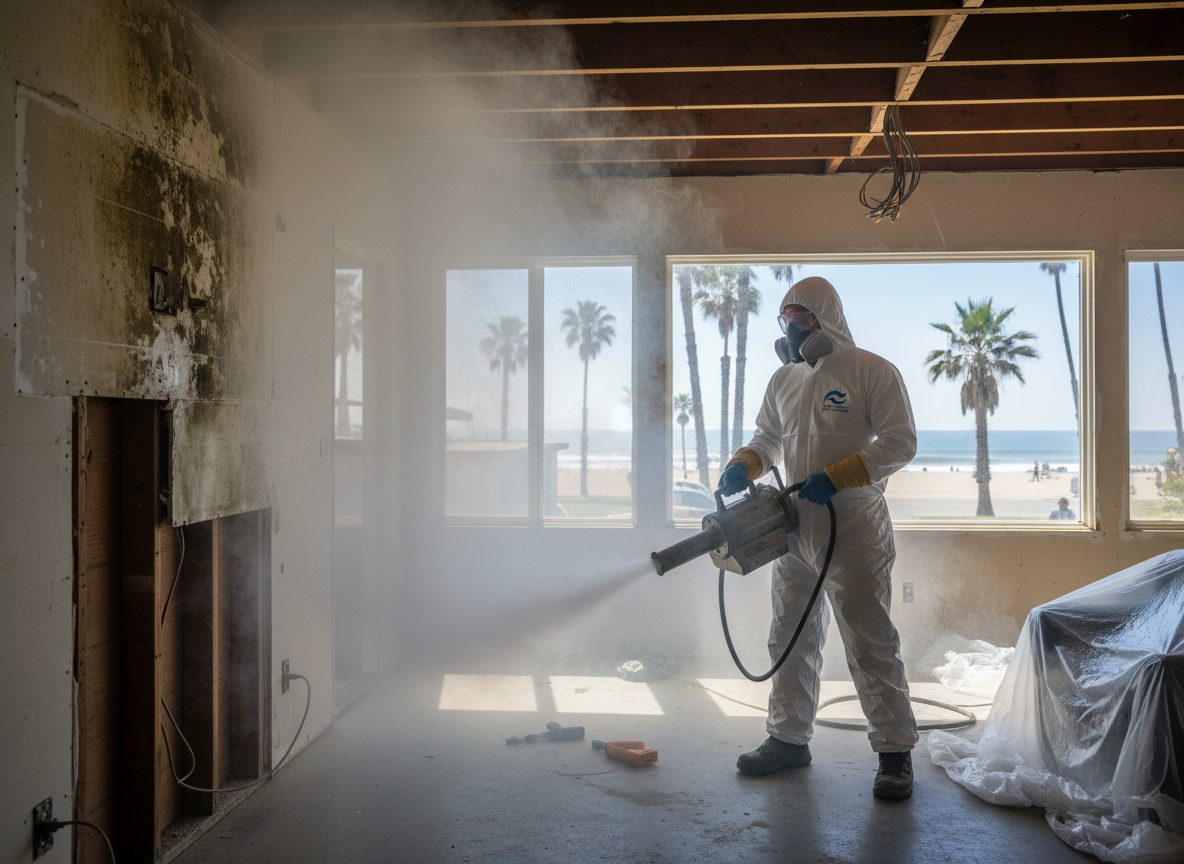
Mold fogging treatment uses a fine mist of EPA-registered antimicrobial agents dispersed through HVAC systems and living spaces to reach hidden spores that traditional wiping misses. In Playa Del Rey Village and the Dockweiler Beach area, the mild coastal climate and frequent marine layer fog keep relative humidity elevated year-round, allowing mold to colonize behind drywall and in crawl spaces of older beach cottages. The process requires sealing the structure first so the fog penetrates every cavity without escaping into neighboring units common in Silicon Beach density.
Technicians calculate dwell time based on square footage and airflow patterns created by Ballona Creek breezes that pull air through many homes. After fogging, negative air machines with HEPA filtration capture residue before ventilation restores safe occupancy levels. Homeowners near Marina Del Rey or Culver City often discover that fogging alone cannot address active water intrusion from roof leaks or poor grading, so the treatment is paired with moisture mapping to prevent recurrence in Los Angeles County properties.
Edge cases include treating attics where salt air from Playa Del Rey Beach accelerates corrosion on metal HVAC components, requiring adjusted chemical concentrations. Code compliance in Los Angeles means following SCAQMD rules on volatile organic compound limits during application, and technicians must document containment to avoid neighbor complaints in attached housing stock.
Technician insight
In Playa Del Rey, the thing that catches most people out with mold fogging treatment is the marine layer fog that keeps indoor humidity high even on sunny days, especially in homes close to Ballona Creek where poor drainage lets moisture wick into slab foundations and defeats a single fog application.
Fog Treatment After Fog-Driven Growth
A homeowner in Playa Del Rey Village noticed musty odors in the hallway after weeks of marine layer. Inspection found hidden growth behind baseboards near a window facing Dockweiler State Beach. We contained the space, applied fog through the HVAC, and ran scrubbers overnight. Follow-up readings confirmed clearance and the owner reported no return of odor after two weeks.
How it works
- 1
Site Assessment
Technicians inspect for visible growth and use moisture meters around windows, bathrooms, and foundations influenced by local fog and creek proximity.
- 2
Containment Setup
Plastic barriers and negative air machines isolate the treatment zone to prevent spore migration into unaffected rooms.
- 3
Fog Application
EPA-registered solution is fogged through ducts and open spaces with calculated dwell time suited to the home's airflow.
- 4
Ventilation and Clearance
Air scrubbers run until readings drop below safe thresholds, followed by a final walkthrough with the owner.
Pricing
Upfront quotes follow inspection; costs reflect square footage, HVAC complexity, and extent of hidden growth common in older coastal homes.