Playa Del Rey homes built before the 1970s often feature raised foundations and crawl spaces that trap moisture from the marine layer fog rolling in from Playa Del Rey Beach and Dockweiler State Beach. When fog lingers for days, relative humidity inside these voids stays elevated long after the air outside clears, allowing mold to colonize insulation, joists, and subflooring. Residents in Playa Del Rey Village and the Silicon Beach corridor frequently discover growth only after noticing musty odors or warped baseboards near Ballona Creek, where tidal influence keeps soil damp year-round.
Standard remediation here requires more than surface cleaning because Los Angeles County building practices from that era used paper-faced drywall and organic insulation that mold penetrates deeply. Technicians must remove affected materials to the studs, apply antimicrobial treatments rated for coastal conditions, and run commercial dehumidifiers until moisture content drops below 12 percent. Failure to address hidden pockets near plumbing penetrations or under kitchen slabs near Marina Del Rey allows rapid regrowth once the next fog event arrives.
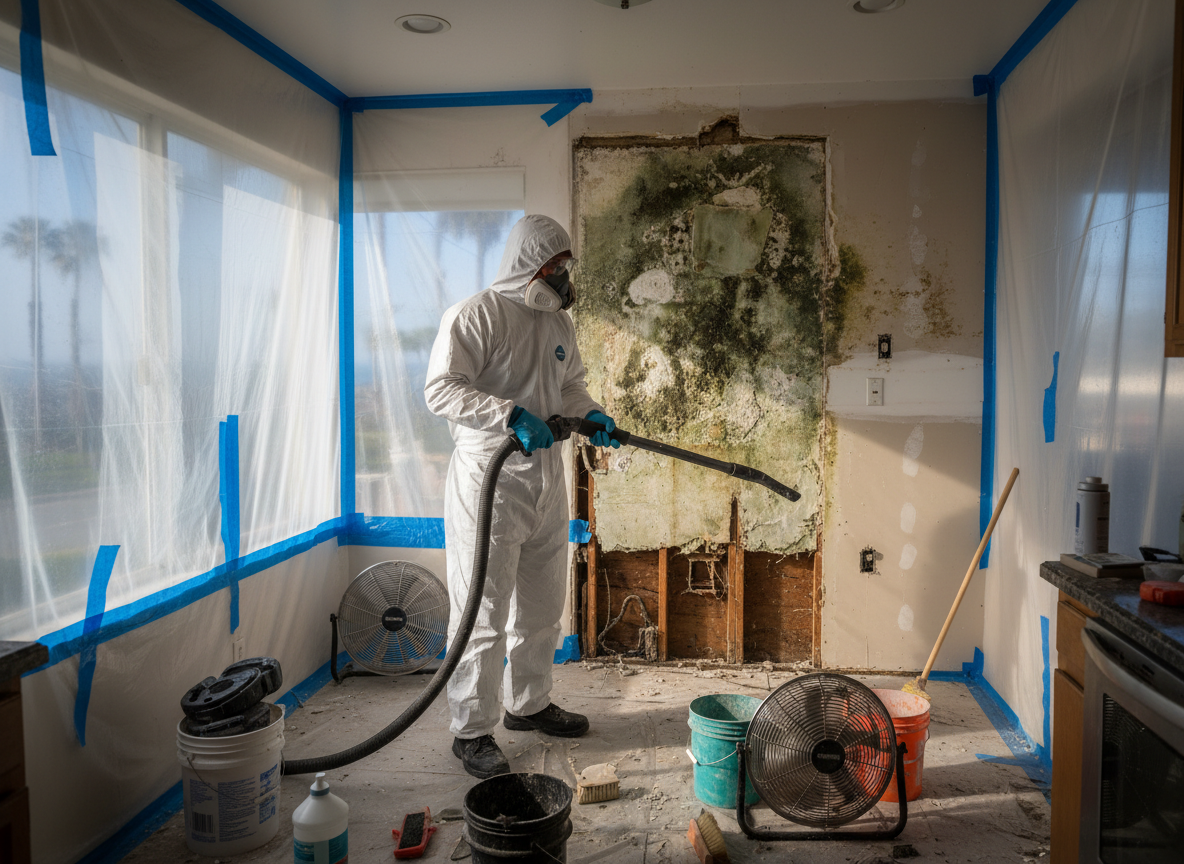
Homeowners sometimes attempt bleach wipes or over-the-counter foggers, but these leave roots intact in the porous stucco and lathe common along Culver City borders. Proper protocol includes negative-air containment to protect adjacent living spaces and HEPA vacuuming of all settled spores before any reconstruction. Because the mild climate masks the problem, many properties reach visible damage before detection, requiring full wall or ceiling disassembly rather than spot treatments.
Technician insight
In Playa Del Rey, the thing that catches most people out with mold cleanup near me is how the marine layer fog keeps crawl spaces under 1960s bungalows near Ballona Creek damp for weeks even when the sun is out. Homeowners often paint over ceiling stains thinking the problem is solved, but the moisture source in the joists remains untouched until we open the space.
Crawl Space Growth After Extended Fog
A homeowner in Playa Del Rey Village noticed a persistent musty smell in the hallway after several weeks of marine layer. Inspection revealed mold on insulation and rim joists above a damp crawl space influenced by proximity to Ballona Creek. We contained the area, removed affected materials, dried the space, and applied treatments. The odor cleared and moisture readings stayed within safe range through the next fog cycle.
How it works
- 1
Initial Assessment
Technician inspects affected rooms, crawl spaces, and attics using moisture meters and thermal imaging to map hidden growth.
- 2
Containment Setup
Plastic barriers and negative air machines isolate the work zone to prevent spore migration into clean areas of the home.
- 3
Removal and Cleaning
Damaged materials are cut out, surfaces are treated, and remaining structure is HEPA-vacuumed and wiped.
- 4
Drying and Verification
Dehumidifiers and air movers run until readings confirm safe moisture levels, followed by post-remediation testing.
Pricing
Cost depends on square footage affected, access to crawl spaces or attics, and whether structural materials must be replaced; upfront quotes provided after inspection.