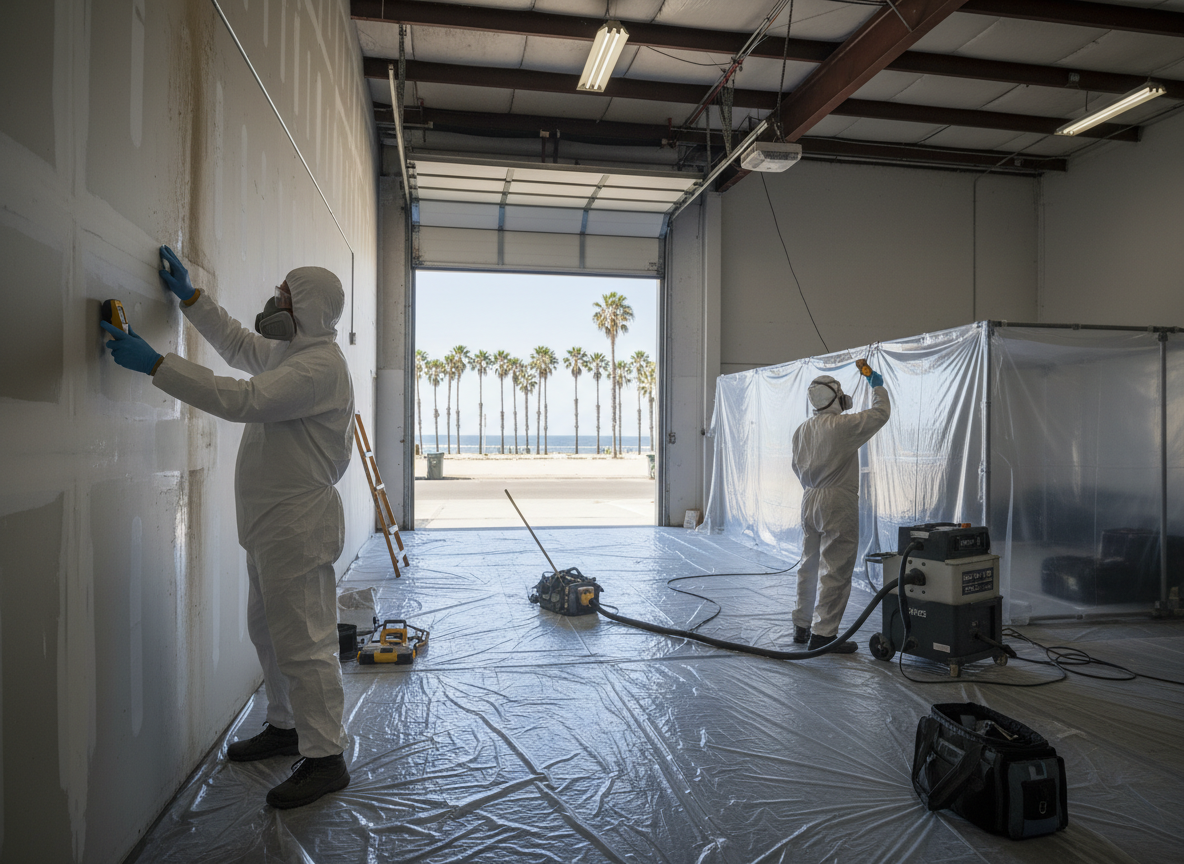
Commercial properties in Playa Del Rey Village and the Silicon Beach corridor often sit on older slab foundations built when codes allowed less ventilation detail around Ballona Creek. Marine layer fog rolls in most nights and keeps relative humidity elevated for hours after sunrise, pushing moisture into wall cavities and above suspended ceilings where HVAC returns pull air across cool concrete. An inspection here starts with thermal imaging and moisture metering at every seam where the roof deck meets the parapet, because that interface collects condensate that standard visual checks miss. Inspectors also pull air samples from tenant spaces that share walls with restaurants or gyms, since those occupancies introduce additional humidity loads that travel through common plenums.
Los Angeles County commercial codes require documentation of moisture sources before any remediation plan can move forward, especially when a building sits within the flood plain influence of Ballona Creek. Crews map every cold-water line and roof drain penetration because even small pinhole leaks stay wet longer under the constant marine layer. In Marina Del Rey and Culver City border properties, inspectors pay extra attention to parking structures beneath offices; those decks trap fog moisture against the underside of the floor slab and feed mold into the first-story walls. The report always includes a floor plan with moisture readings so property managers can see exactly which suites need follow-up before lease renewals.
Edge Cases in Coastal Commercial Stock
Fog-driven condensation often appears first behind vinyl wall coverings in conference rooms that face west toward Dockweiler State Beach. These rooms stay cooler at night and collect moisture that never fully dries before the next marine push. Inspectors also check elevator shafts and fire stairwells because stack effect pulls humid air upward and deposits it on the top-floor slab edges.
Regulatory Notes for Los Angeles County
Any commercial inspection that finds visible growth over ten square feet triggers the requirement for a written remediation protocol under county health guidelines. Reports must note whether the building uses single-ply roofing, because those membranes fail at seams when fog keeps the surface damp for weeks. Property owners receive a separate summary they can share with tenants without revealing proprietary HVAC details.
Technician insight
In Playa del Rey, the thing that catches most people out with Commercial mold inspection is the marine layer fog that keeps humidity trapped against west-facing walls near Ballona Creek; older commercial stock in Playa Del Rey Village often has single-wythe masonry that never dries between fog events, so readings taken only during the day miss the overnight spike.
Second-Floor Office Over Retail Near Dockweiler
The property manager noticed musty odor only in the afternoons. Inspection found the roof drain scupper above the suite had been dripping onto the parapet for months; fog kept the masonry saturated. Thermal imaging showed moisture tracking down the wall cavity into the return plenum. Samples confirmed elevated spores in the shared HVAC. The report gave the manager a targeted drying plan and county-compliant protocol so the space could reopen without full gut renovation.
How it works
- 1
Site Walk and Moisture Mapping
Technician records humidity and temperature at multiple elevations while noting every roof drain, HVAC intake, and exterior wall that faces the prevailing marine layer.
- 2
Thermal and Probe Testing
Infrared scans locate temperature differentials behind walls and ceilings; pin meters confirm actual moisture content at suspect locations without damaging finishes.
- 3
Air and Surface Sampling
Spore trap and tape-lift samples are collected from occupied and unoccupied zones, then compared against outdoor baselines taken near Playa Del Rey Beach.
- 4
Report and Protocol Delivery
Findings are plotted on a building diagram with moisture readings and recommended next steps that satisfy Los Angeles County documentation needs.
Pricing
Pricing scales with square footage and number of tenant spaces; an upfront quote follows the initial site walk.