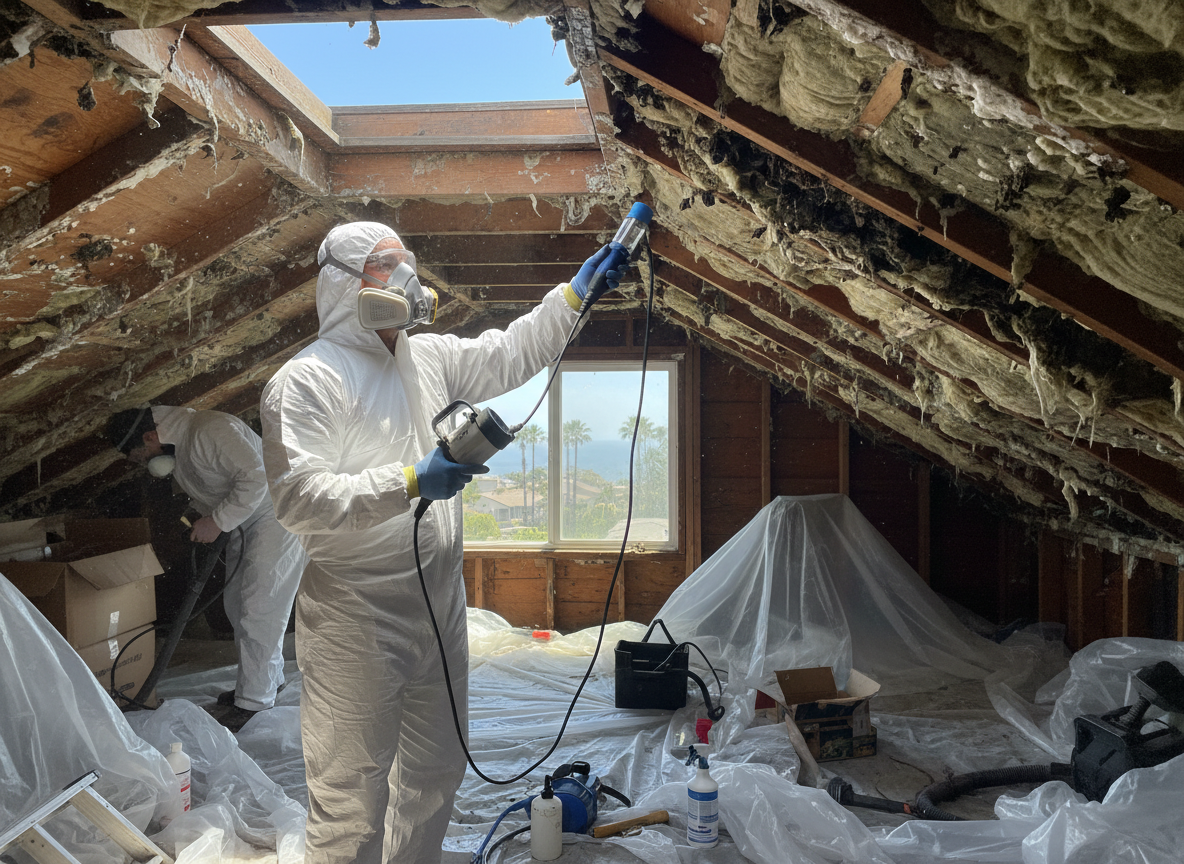
Playa Del Rey homes built before the 1970s often feature rafter construction with limited ridge venting, allowing marine layer fog from the Pacific to condense on roof sheathing during overnight temperature drops. This moisture soaks into insulation batts and wood members near the eaves, especially in structures along Pacific Avenue and in Playa Del Rey Village. When left unchecked, black mold colonies form on the back side of drywall ceilings and around recessed lighting fixtures. Testing requires lifting insulation sections and using moisture meters on the roof deck rather than relying solely on surface swabs, because the growth frequently stays hidden until it migrates toward Ballona Creek side properties where humidity stays elevated year-round.
Removal work in these attics must account for narrow access hatches common in Silicon Beach bungalows and the risk of disturbing asbestos-containing duct tape on older HVAC runs. Technicians establish negative pressure with HEPA-filtered air scrubbers before disturbing any material, then bag contaminated insulation and treat framing with EPA-registered antimicrobials that penetrate porous wood. Los Angeles County building codes require verification that any replaced insulation meets current R-value standards, so crews document existing conditions before work begins. Homeowners along Dockweiler Beach frequently report recurring odors after simple bleach cleaning because the source remains in the attic cavity where fog continues to deposit moisture.
Edge cases include mold growth inside bathroom exhaust ducts that terminate short of the roofline, allowing moist air to re-enter the attic space. In homes near Marina Del Rey, tidal influences on Ballona Creek can raise local humidity enough to push dew points inside poorly sealed attics during spring and fall. Proper remediation includes sealing those duct terminations and adding continuous ridge vents where roof geometry permits, preventing the cycle that brings clients back within two seasons.
Technician insight
In Playa Del Rey, the thing that catches most people out with Attic mold testing and removal is the marine layer fog that rolls in nightly from Dockweiler State Beach and settles into the unvented eaves of older bungalows near Ballona Creek, creating hidden condensation that never dries out between fog events.
Hidden Condensation in Playa Del Rey Village Attic
Homeowner noticed a musty smell after several weeks of heavy morning fog. Inspection revealed mold colonies on the underside of roof sheathing where insulation had absorbed moisture from the marine layer. Crews contained the space, removed wet batts, treated framing, and added ridge venting to restore airflow.
How it works
- 1
Initial Assessment
Technician arrives within hours, maps attic access points, and checks for visible moisture trails from the marine layer.
- 2
Air and Surface Sampling
Collects spore trap and tape lift samples from multiple attic zones to identify mold types and concentration levels.
- 3
Containment Setup
Installs plastic barriers and negative air machines to isolate the attic from living spaces below.
- 4
Removal and Treatment
Removes affected insulation, cleans framing, and applies antimicrobial solution to all exposed wood surfaces.
- 5
Post-Remediation Verification
Runs clearance air sampling and provides written report before restoring attic access.
Pricing
Project pricing reflects attic volume, extent of hidden growth behind insulation, and any required ventilation upgrades.