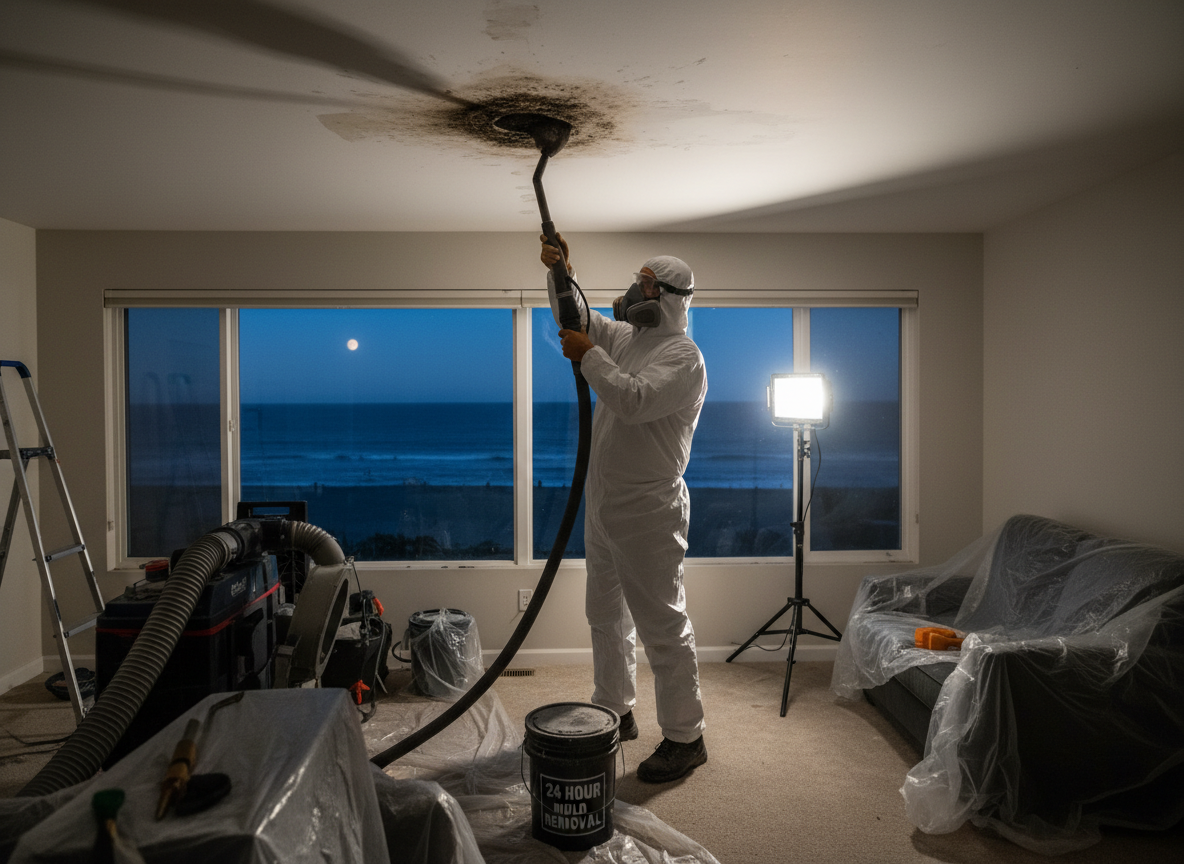
Playa Del Rey homes built close to Ballona Creek and Dockweiler State Beach often see moisture intrusion from the persistent marine layer fog that rolls in from the Pacific. This fog keeps relative humidity elevated for days, allowing mold to establish in attics, under floorboards, and inside wall cavities of the older bungalows common in Playa Del Rey Village and the Silicon Beach corridor. Standard household dehumidifiers rarely pull enough moisture from these hidden spaces, so visible surface cleaning alone leaves colonies that return within weeks once the next fog event arrives.
Containment becomes critical near the creek because water can travel under slab foundations or through shared walls in attached properties. Technicians must map moisture with meters before cutting drywall, then use negative air machines to prevent spores from drifting into adjacent rooms or out to Playa Del Rey Beach paths. In Los Angeles County, any job that disturbs more than ten square feet of moldy material triggers specific disposal and documentation steps that protect both the property and neighboring homes in Culver City and Marina Del Rey.
After physical removal, verification includes both visual inspection and air sampling to confirm spore levels have returned to normal outdoor baselines. Homes along Pacific Avenue frequently require follow-up drying of subfloor areas because the sandy soil retains humidity longer than inland sites. Skipping this step allows regrowth the moment the next marine layer settles over the neighborhood.
Technician insight
In Playa Del Rey, the thing that catches most people out with 24 hour mold removal is how marine layer fog keeps crawlspaces under 1950s homes near Pacific Avenue damp for weeks. Homeowners often run box fans thinking they are drying the space, yet the fog simply reintroduces moisture overnight and the colonies rebound.
Hidden Growth in a Village Bungalow
Problem: Musty odor reported after several days of thick fog. Found: Moisture trapped behind kitchen drywall in a home adjacent to Ballona Creek. Did: Set containment, removed affected sections, dried subfloor, and cleared with air sampling. Outcome: Property returned to normal use the following day with no recurrence during the next fog cycle.
How it works
- 1
Initial Assessment
Technician arrives within hours, documents visible growth, and uses moisture meters to locate hidden water near Ballona Creek or under coastal foundations.
- 2
Containment and Air Filtration
Plastic barriers and negative air machines isolate the work zone so spores do not spread to unaffected areas of the Playa Del Rey home.
- 3
Removal and Cleaning
Affected materials are removed, surfaces are treated, and HEPA vacuuming captures remaining spores in attics and crawlspaces common to local housing stock.
- 4
Drying and Verification
Industrial drying targets residual moisture from marine layer fog, followed by clearance testing before the space is returned to use.
Pricing
Upfront quotes provided after inspection; final cost depends on extent of hidden growth tied to coastal fog and proximity to Ballona Creek.